Moto Rider GO: Highway Traffic
- 4.3
- Rating
- 100.00M
- Installs
- Free
- Price
 Analysis by App-foxy
I installed Moto Rider GO: Highway Traffic expecting a quick mobile racing game, and that is exactly where it makes the strongest first impression. From the opening moments, the focus is clear: get on a motorcycle, move through traffic, react quickly, and keep the ride going. It does not ask me to learn a complicated racing simulation before I can enjoy it. The appeal is immediate, visual, and easy to understand, which makes it a natural choice when I want a short session rather than a long, carefully planned race.
That simplicity is also the key to judging it fairly. This is not trying to replace a full console-style motorcycle simulator, and it is not built around the deep tuning systems found in more demanding racing games. It is an accessible motorcycle traffic racer designed around movement, timing, and the feeling of threading through a busy road. I found that its best moments came when I stopped treating each run like a conventional race and started treating it as a test of concentration.
The game comes from T-Bull S A and is available free of charge, with optional purchases ranging from $0.21 to $25.37 per item. It is rated for Everyone, so its presentation is broadly approachable. The Android release requires version 7.0 or later, and the current version is 1.95.43. Those details make it easy to place on an older compatible phone, although the experience will still depend on how smoothly that device handles a fast-moving 3D road scene.
You May Also Like

 Blood Strike: 2.5 Anniversary
Blood Strike’s Loadouts Turn Every Drop Into a Tactical Gamble
A close look at Blood Strike’s custom loadouts: how fast access to signature weapons reshapes its battle royale rhythm, rewards preparation, and narrows the gap between fights.

 Pandora - Music & Podcasts
Pandora’s Music Is Easy to Start, but Harder to Recover
Pandora’s strength is its low-effort path from a seed to a station. Its weak spot is how much confidence it asks you to place in connection, setup, and quiet recovery.

 8 Ball Pool
 Is Built on Rivalries, Rematches, and Routine
A close look at the rivalries, rematches, shared routines, and unanswered safety questions that turn a quick pool match into a persistent mobile community.

 Samsung Music
’s Quiet Strength Is Playing What You Already Own
Its reach comes less from spectacle than from dependable access to a personal library. That simplicity is both the app’s strongest retention engine and its ceiling.

 AccuWeather: Weather Radar
AccuWeather Review: A Quick, Clear Forecast for Everyday Decisions
For everyday plans, the best forecast is the one you can understand quickly. AccuWeather makes rain timing, radar, and local conditions easy to act on, with a few trade-offs.

 Hill Climb Racing
Why Hill Climb Racing Still Turns Crashes Into One More Run
A tiny car, a bumpy hill and one more upgrade: Hill Climb Racing keeps resurfacing because its simple chaos makes every near-miss feel personal.
More From Our News Desk
View All News


How the first ride establishes its mood
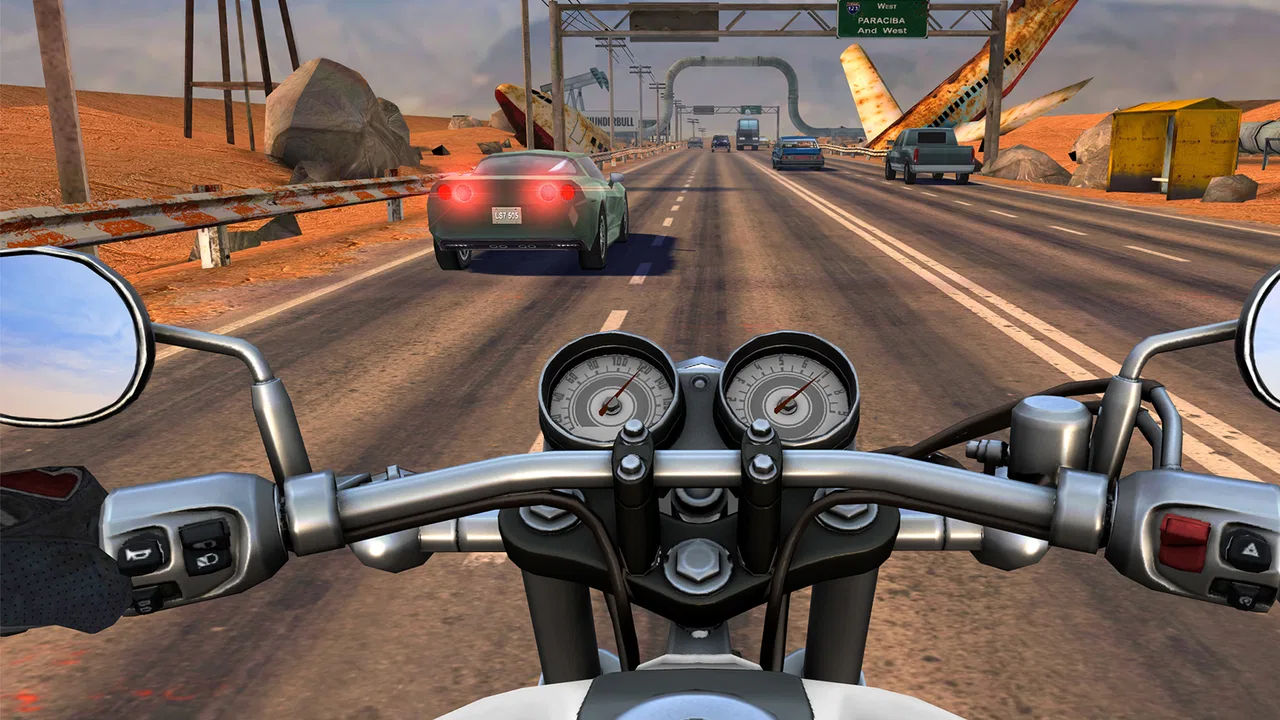
The first thing I noticed was how quickly the game communicates speed without burying the player in instructions. The road stretches forward, traffic becomes the immediate obstacle, and the motorcycle gives the whole experience a low, exposed perspective. That viewpoint matters: cars and trucks feel like objects I have to read rather than decorations passing in the background. A small movement at the wrong moment can turn a comfortable ride into a collision.
This creates a useful kind of tension. The controls are approachable enough for a casual player, but the road demands attention from the beginning. I do not need racing knowledge to understand what to do, yet I still have to develop a feel for spacing, timing, and when a gap is genuinely safe. That balance is one of the reasons the game works well for short breaks. I can start playing almost immediately, but a good run still feels earned.
The free-to-play structure is visible in the way I think about progress. A new player can begin without paying, which removes the biggest barrier to trying it. At the same time, optional purchases mean that anyone who dislikes in-game spending should approach it with a clear personal limit. I would recommend deciding that limit before a long session, especially if the desire to improve a run starts turning into the desire to buy a shortcut or extra convenience.
One practical use case is a commute or waiting-room session where I have only a few minutes. The game suits that situation better than a story-heavy racing title because I can focus on one ride and stop. It also works when I want something more active than a puzzle but less demanding than a competitive online match. I would not choose it for a relaxed evening built around exploration, because its central pleasure comes from constant forward motion and quick reactions.
A road that communicates more than scenery
The setting is built around the highway, and that choice gives the game a coherent visual language. The road is not merely a track with barriers placed along it. It is the main stage, and traffic gives it its character. Vehicles create changing lanes, closing opportunities, and visual distractions. Because the motorcycle is surrounded by larger road users, the setting naturally makes me feel vulnerable and alert.
I like that the environment supports the mechanics instead of competing with them. A motorcycle game can easily become a collection of attractive backgrounds with little relationship to play, but here the road surface, lane arrangement, and vehicle flow are part of the decision-making. I am constantly scanning forward, looking past the nearest vehicle, and trying to understand what the next few seconds might require. The art direction therefore has a practical role: it helps build the mood of risk while keeping the objective readable.
The game’s visual identity is more about motion and contrast than about a large narrative world. I do not play it to discover characters or uncover a detailed setting. I play it to inhabit the narrow space between my bike and the traffic around it. That makes the experience focused, but it also means players who want varied environments, a strong story, or extensive customization may find the presentation limited compared with broader racing alternatives.
A useful tip is to avoid staring only at the motorcycle directly ahead. I get better results when I read the traffic farther down the road and use the nearer vehicles as part of a larger pattern. This changes the game from frantic swerving into a more deliberate flow exercise. The visual design rewards anticipation, and that is one of its less obvious strengths.
The highway setting also explains why the game can feel repetitive if I play for too long. The same basic visual problem remains at the center of every session: find space, maintain control, and avoid traffic. For short bursts, that repetition is comforting because I know what kind of challenge I am getting. During extended play, however, I start wanting more environmental change or a stronger sense of progression to refresh the mood.
Sound, speed, and the rhythm of concentration
Sound plays an important supporting role because a traffic game needs to feel active even when the basic action is simple. The motorcycle engine gives the ride a forward pulse, while the movement of surrounding traffic reinforces the sense that the road is alive. I found that the audio works best when I use it as part of the rhythm of play rather than expecting it to carry the entire atmosphere by itself.
The pacing is not based on long cinematic build-up. It begins with the road and lets tension grow through proximity. A clear stretch gives me a moment to settle into the ride, then a cluster of vehicles forces a decision. That alternating pattern creates a playable mood: calm enough to understand what is happening, but unstable enough that I cannot switch off completely. The sound and visuals work together to make those changes noticeable.
I recommend playing with audio enabled at least once before deciding whether it matters to you. With the sound muted, the game becomes more mechanical and I rely almost entirely on visual timing. With audio present, the ride feels more like a continuous activity, which helps preserve immersion during repeated attempts. Players who usually listen to podcasts or music may prefer silence, but the trade-off is that the highway atmosphere becomes flatter.
The rhythm also affects how I handle mistakes. If I rush after a near miss, I usually make another poor decision because I am reacting emotionally rather than reading the road. The better approach is to treat a close call as a reset point: regain a stable line, look farther ahead, and wait for the next usable opening. This is a small habit, but it makes the pacing feel less chaotic and gives the game more depth than its simple controls initially suggest.
There is a clear difference between this kind of audio-led momentum and the presentation of a traditional circuit racer. A circuit game often emphasizes laps, cornering, braking points, and the satisfaction of learning a fixed route. Here, the mood comes from an apparently continuous highway and the unpredictable arrangement of traffic. If I want precise corner practice, another racing game is likely a better fit. If I want a portable concentration loop built around speed and avoidance, this approach is more suitable.
Why the mechanics fit the atmosphere
The central mechanics are easy to understand, but their simplicity should not be confused with a lack of decision-making. The important question is rarely just whether I can move left or right. It is whether I should move now, whether the opening will remain available, and whether passing one vehicle will leave me prepared for the next one. The highway setting gives those basic actions context, so every movement contributes to the feeling of risk.
I found the game most satisfying when I played with restraint. New players may be tempted to make constant corrections because the road feels fast, but unnecessary movement creates its own danger. A smoother line leaves more attention available for traffic. This is a concrete advantage of the straightforward control scheme: once I stop overcorrecting, I can concentrate on reading patterns instead of wrestling with the interface.
That design makes it approachable for people who are not regular racing fans. Someone who finds simulation games intimidating can understand the goal within seconds. The game is also a reasonable choice for children and families because its Everyone rating signals a broadly accessible presentation. Still, younger players may need guidance around optional purchases, not because the riding itself is difficult to understand, but because free games can make continued progress feel tempting.
For experienced racing players, the trade-off is different. The immediate challenge is enjoyable, but the experience may not offer enough mechanical variety if you want detailed bike setup, realistic handling, or a large competitive structure. I would skip it if my main priority were authentic motorcycle physics or a comprehensive career mode. I would also look elsewhere if online competition against other riders were essential to my decision, since the appeal here is centered on the individual ride and the traffic challenge.
One of the more useful ways to play is to divide a session into goals that are not purely about going farther. I might focus on maintaining a clean line through dense traffic, then switch to practicing patience in open stretches. This prevents every attempt from feeling like a single all-or-nothing score chase. It also reveals whether I actually enjoy the moment-to-moment riding or only the idea of beating a previous result.
The game’s free entry point is another mechanical consideration. Because I can try the core experience without paying, I can judge its handling before deciding whether it belongs on my phone. That is important here because the game’s appeal is very specific. If the highway rhythm feels satisfying after several short sessions, the optional purchase structure may be acceptable to me. If the repeated traffic pattern already feels tiring, spending money will not solve the underlying mismatch.
Who will enjoy the highway loop most
I think this game is best for players who want an instantly readable racing experience with a strong sense of forward movement. It suits someone who enjoys reflex challenges, quick restarts, and gradually improving their awareness of traffic. It is especially comfortable as a short-session game: I can play while waiting for an appointment, take a break between tasks, or use it as a brief way to reset my attention after work.
It can also work for a player who likes the idea of motorcycles but does not want to learn a complicated simulation. The road gives enough pressure to make each run meaningful, while the controls remain approachable. The setting, engine sound, and traffic flow create a consistent mood rather than a collection of disconnected mechanics.
I would be more cautious about recommending it to someone who needs a large sense of progression. The game’s strongest identity is the ride itself, not a deep narrative or a broad role-playing system. Likewise, players who dislike repeated attempts, free-to-play purchase prompts, or the possibility of visual sameness may prefer a paid racing game with a more structured campaign.
Compared with a kart racer, this feels less playful and more focused on road awareness. Compared with a motorcycle simulator, it is far easier to pick up but less concerned with realism. Compared with a traditional lap-based racer, it replaces corner memorization with traffic reading. Those distinctions are more useful than simply calling it a racing game, because they show exactly where its appeal sits.
My final view of the atmosphere and the ride
After spending time with it, I see Moto Rider GO: Highway Traffic as a focused arcade motorcycle game whose art direction, sound, and pacing all support one clear idea: staying in motion while the highway keeps presenting new risks. Its visual world is not expansive, but it is coherent. Its audio is not the whole experience, but it gives the ride a stronger pulse. Its mechanics are simple, yet traffic turns simple movement into a steady test of judgment.
The biggest strength is that the mood never loses contact with play. The highway looks and sounds like a place where attention matters, and the mechanics make me prove that attention through every gap I attempt. The biggest limitation is the same focus: players looking for deep simulation, extensive variety, or a story-led racing journey may quickly reach the edge of what this format offers.
With an average rating of 4.3 from around 927 thousand ratings and over 100 million installs, it has clearly found a substantial audience. Those figures do not replace personal taste, but they match my impression that the game is easy to approach and satisfying for the right kind of player. I would recommend trying it if you want a free motorcycle traffic challenge that works in short bursts and rewards calmer reactions than its speed initially suggests.
My practical recommendation is to install it, play several brief sessions with the sound on, and pay attention to whether you enjoy reading the road rather than merely surviving it. Keep optional spending deliberate, use distant traffic as your main visual reference, and take a breath after every near miss instead of immediately making another move. If that rhythm feels good, this is a compact and atmospheric racer worth keeping. If you need realistic bike handling or a much broader racing world, choose a different type of game instead.
FAQs for Moto Rider GO: Highway Traffic
01What types of motorcycles can I use in Moto Rider GO: Highway Traffic?
Moto Rider GO offers a variety of motorcycles to choose from, including choppers, sport bikes, and superbikes. Each type of motorcycle has different handling characteristics and performance stats, allowing players to select the best fit for their style. As you progress in the game, you can unlock and customize new bikes to enhance your gaming experience.
02How does customization work in Moto Rider GO: Highway Traffic?
Customization in Moto Rider GO allows players to personalize their bikes with various upgrades and visual modifications. You can enhance your motorcycle’s performance by upgrading its engine, brakes, and handling. Additionally, players can change the bike's appearance with different colors and decals, making it unique to their style and preferences.
03Are there different game modes in Moto Rider GO: Highway Traffic?
Yes, Moto Rider GO offers several game modes to keep the gameplay exciting. Players can choose from One Way, Two Way, Time Trial, and Police Chase modes, each providing a unique challenge and experience. These modes allow players to test their skills in different traffic scenarios and compete for higher scores.
04Is Moto Rider GO: Highway Traffic free to play?
Moto Rider GO is free to download and play, but it includes in-app purchases. Players can buy additional currency or premium items to enhance their gaming experience. While purchases can speed up progress and customization, they are entirely optional, and players can enjoy the game without spending money.
05Does Moto Rider GO: Highway Traffic require an internet connection?
Moto Rider GO can be played offline, which means you can enjoy the game anytime, anywhere, without needing an internet connection. However, some features like leaderboards and in-app purchases require an internet connection to function properly, so it's beneficial to connect occasionally for the full experience.
Pros
- Stunning graphics with realistic environments.
- Smooth controls enhance the gaming experience.
- Varied missions keep gameplay exciting.
- Daily rewards encourage regular play.
- Customization options for bikes and gear.
Cons
- In-app purchases can be expensive.
- Ads can interrupt gameplay frequently.
- Limited offline features available.
- Repetitive gameplay may occur over time.
- Requires a stable internet connection.

Moto Rider GO: Highway Traffic
Gallery